| The Sandisfield Times |
|---|
| A 50-Foot Lee Bridge Costs $8 Million to Replace. Why? |
|
By Nate Harrington The Berkshire Eagle. Reprinted with permission. September 17, 2026 |
|
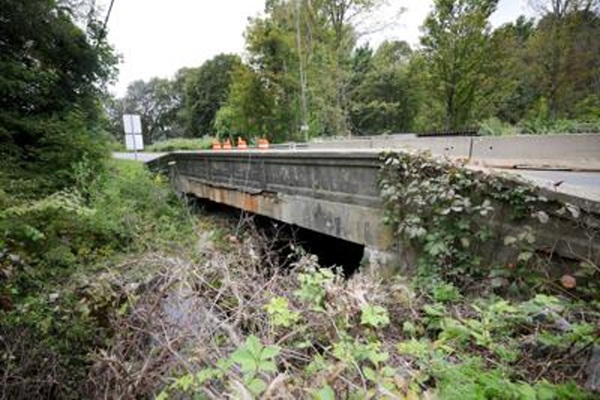
The Mill Street bridge over Washington Mountain Brook in Lee is visibly decaying. Replacing it will cost $8 million. (Photo: Stephanie Zollshan, The Berkshire Eage.) |
|
Editor's Note: Fixing anything on our roads in Sandisfield costs a whole lot of money, whether it's to replace a culvert, a wee little bridge, or pave a section of dirt road that washes out after every spring freshet. The Berkshire Eagle story, reprinted here with permission, explains much of the reasons the cost is so high, but it doesn't make us feel better. LEE - The Mill Street bridge that spans Washington Mountain Brook is about 50 feet long and takes less than 15 seconds to walk across. In 2025, as the bridge's structure deteriorated, traffic was restricted to one lane, with alternating one-way traffic. Drivers traveling in opposite directions take turns crossing, with only a stop sign at each end of the bridge to determine who goes first - if drivers stop at all. The 1911 bridge is small, but it is a big headache for neighbors concerned about roadway safety. Mike Coty, who crosses the bridge almost every day on his three-mile walk, said drivers routinely ignore the stop signs. "That's why I got this," he said, holding up his pointed walking stick. "Once in a while, I have to bring it up, let them know I'm near." As he spoke, Coty pointed to a government truck that had just blown through the stop sign, illustrating his estimate that about 20 percent of drivers do the same. Despite spanning just 50 feet, replacing the Mill Street bridge is expected to cost more than $8 million - roughly $160,000 for every foot of bridge - a figure that reflects far more than the concrete and steel needed to cross Washington Mountain Brook. Engineering, permitting, environmental requirements, drainage, utilities and construction all add to the cost, illustrating why even small bridge projects can be such a financial challenge for municipalities and the state. "That's the reality of how they're designed," said William Tyrell, chief estimator at Northern Construction, a Massachusetts company that builds bridges and does repairs. "A bridge built now is going to be cheaper than a bridge built five years from now, and that's just reality." No matter how much repairs cost, it has to be done right and to code, Tyrell said. When a road fails, it may lead to damage to the car, like a flat tire, Tyrell said. "What happens if a bridge fails?" he asked. "Nothing good. People get hurt, or worse." Why Moswen Bridges Cost More The estimated cost to replace the Mill Street bridge pales in comparison with some other bridge projects in the Berkshires. The Brookside Road Bridge in Great Barrington, for example, is projected to cost $50 million. The two projects are among the many bridge replacements and repairs underway or planned across the county, where much of the infrastructure dates to the early decades of the automobile. Bridges built more than a century ago weren't designed to meet today's engineering standards, carry today's traffic or withstand the range of conditions modern bridges are expected to endure. "Some of the bridges that we drive over are just masonry rubble abutments on a spread footing, and then the bridge is built over that," Tyrell said. "It's safe, but it would never meet modern codes." Bridge construction has evolved over years of research, testing and, unfortunately, failure, said Simos Gerasimidis, associate professor of civil and environmental engineering at the University of Massachusetts Amherst. "Design codes have evolved substantially," Gerasimidis said. "Engineers can now model complicated structural behavior that would have been extremely difficult to analyze several decades ago." Designed for Worst-Case Scenarios Before a bridge can be replaced, however, the need has to be identified and the project designed. MassDOT prioritizes bridge repair projects using "a relative ranking system which, amongst other factors, considers current condition, future condition and bridge usage," said John Goggin, communication analyst with the department. Once a bridge is identified as needing repair or replacement, a new design needs to be drawn up. Modern designs are built to last 75 to 100 years and withstand worst-case scenarios, like extreme weather and flooding, Tyrell said. To assess a bridge's safety, researchers create mathematical models that show how cars and trucks will load and stress the structure, Gerasimidis said. For more complicated bridges, there are sometimes millions of elements that the computer is tracking and modeling to generate data about how the design will hold up. "When we design a bridge, we do not design it so that the expected traffic load brings the structure anywhere close to failure," he said. All of those considerations are built into the design of the bridge itself. But the bridge structure accounts for only about one-sixth of the Mill Street project's $8 million price tag: $1.5 million, according to MassDOT. So where does the other $6.5 million go? All the Other Costs Out of every line item in the Mill Street bridge project breakdown, only one other eclipsed the million-dollar mark: Drilled micropiles at $1.77 million. Older bridges were often built on structural supports called spread footings, which were dug 4 or 5 feet into the ground, Tyrell said. If a bridge using that support is over a river, like the Mill Street bridge is, a flood can potentially wash it out. Micropiles, on the other hand, are drilled into bedrock, he said. The install requires specialty equipment, which makes it more expensive. In the Mill Street project, there are 24 micropiles that are each drilled 10 feet into the ground to support the bridge, Goggin said. But before that can even happen, there is a lot of work to prepare the area around the construction site. "You have to protect the work from the river," Tyrell said. "There's all sorts of design engineering costs that go into planning the work." This work can include figuring out the number of trees that need to be cleared, installing barriers to keep sediment out of the work area, supporting the crumbling bridge while it's still in use and accounting for a temporary traffic light that will control vehicles during construction. All of these line items add up, contributing to the cost of the overall project. And the cost of labor and materials rising means the project cost rises too. "Things have gone up, you know, 30, 40 percent since COVID," Tyrell said. Still, experts say it's worth remembering that when you pay to repair a bridge, you're not just paying for steel and concrete. "You are paying for a structure that has to safely carry millions of vehicles, often for 75 or 100 years, while being exposed continuously to water, salt, temperature changes, wind, snow, fatigue and sometimes floods, earthquakes or vehicle impacts," Gerasimidis said. In Lee, Coty is eager to have his neighborhood bridge repaired, which is expected to be completed by 2030, no matter the cost. "They let it go so far," he said about the condition of the bridge. "We don't have much of a choice." |

|
©The Sandisfield Times. All rights reserved.
Published October 1, 2026