| The Sandisfield Times |
|---|
| Ticks, Ticks, And More Ticks
The Vampires of the Woods |
|
by Tom Christopher Published August 1, 2026 |
|
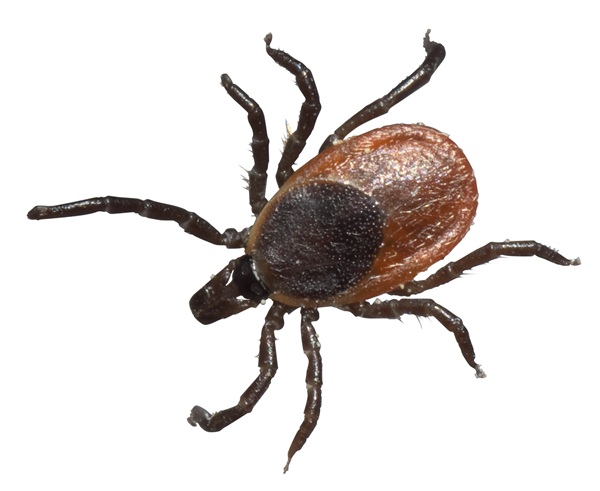 (Photo: Wikipedia.) |
|
It has been quite a year for ticks throughout New England, certainly in my corner of Sandisfield. In late June, for example, when my wife took a visiting friend for a walk on the Yanner Park trail, they each picked ten ticks off their clothes and skin upon their return. I spend most of my days outdoors in my vegetable garden and little orchard and though that is less favorable habitat for ticks than undisturbed woods, I nevertheless have to remain vigilant. I make a careful survey at night with my wife's help before I go to bed. Even so, I sometimes awaken to feel a tick crawling on me. In short, ticks and the diseases they may bring with them are having a significant impact on my enjoyment of Sandisfield's greatest attraction, our beautiful landscape. I know a number of people who, because of their fear of ticks, refuse to venture off safe terrain such as sidewalks and short-mown lawns. In search of a more effective response to this problem, I contacted Dr. Richard Ostfeld of the Cary Institute of Ecosystem Studies in Millbrook, New York. Dr. Ostfeld, or Rick as he preferred to be called, has been studying the ecology of ticks and of tick-borne diseases for more than 30 years. In a conversation that I recorded and subsequently played on my weekly radio program, "Growing Greener," Rick quickly disabused me of some misconceptions.
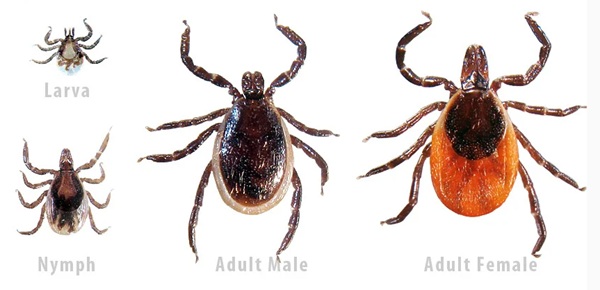 The Blacklegged Tick (Ixodes scapularis). (Photo: The University of Rhode Island.) There are three principal species of ticks in Massachusetts, the black-legged tick, the American dog tick, and the lone star tick. At each stage in their life - larva, nymph, and adult - ticks of all these species use a meal of blood drawn from some other, usually warm-blooded creature, to fuel its growth and development. In particular, adult females cannot produce the eggs that are the foundation of the next generation, without such a meal.
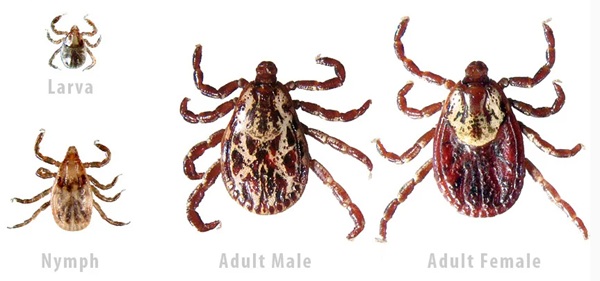 The American Dog Tick (Dermacentor variabilis). (Photo: The University of Rhode Island.) It is in drawing this blood that the ticks both acquire and transmit diseases. Feeding on an infected animal as a larva or nymph makes the ticks carriers, and when an infected adult female feeds before egg laying, she may transmit the disease to her blood source such as an unfortunate hiker. The diseases vary with the species of ticks and include at least nine different pathogens ranging from ehrlichiosis and Rocky Mountain fever to Alpha Gal Syndrome, which has gained a lot of attention recently because of the allergy to red meats it causes.
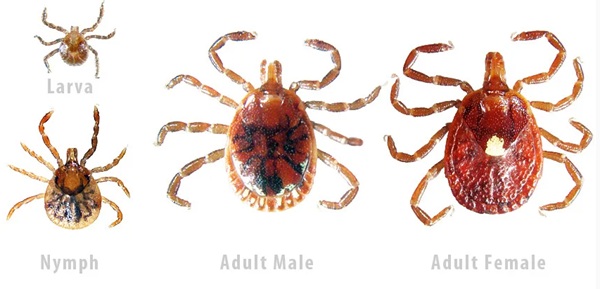 The Lone Star Tick (Amblyomma americanum). (Photo: The University of Rhode Island.) The most serious of these diseases by far is Lyme Disease; the Centers for Disease Control estimates that it infected 476,000 Americans every year. The black-legged tick, the species that transmits Lyme Disease, is often called "deer tick" because that animal is one of its hosts. Like many other people who spend time in the woods, I had noticed that the explosion in the deer population over the last few decades had accompanied a spread of Lyme Disease and I assumed that these two events were linked. Not so, Rick Ostfeld told me. In fact, it is the white-footed mouse that most often serves as the source of blood and Lyme Disease infections for the black-legged tick. White-footed mouse populations have expanded throughout our region, according to Rick Ostfeld, as humans have fragmented the local forests through building and development and reduced numbers of mouse predators such as foxes and owls. By dividing the natural landscape into building lots, we have also separated mouse populations into islands of interbreeding individuals. Once the Lyme Disease bacteria infects one mouse, it tends to become general through that isolated population as the mice are not harmed by that pathogen. This increases the chances of black-legged ticks in the areas becoming carriers and sources of infection to people. Is spraying your yard with a pesticide to reduce the tick population an effective way to reduce your threat of infection?
According to Rick Ostfeld, it is not. In partnership with Dr. Felicia Keesing of Bard College, he conducted a 5-year experiment in treating whole suburban neighborhoods with either baited boxes that applied a pesticide to the mice within a yard or spraying the yard with a fungus known to be fatal to ticks. Some yards were left untreated to serve as a control and contrast the outcome of a lack of treatment. What Ostfeld and Keesing found was that although the fungus had little effect on tick populations within a yard, the baited boxes would reduce it by a half. However, the reduction in tick numbers had no significant effect on the chances that human inhabitants would become infected with Lyme Disease. And, Ostfeld warns, the pesticides commonly used by pest control companies to spray yards for ticks, even the organic ones such as cedar or peppermint oil, also have a negative impact on a variety of other creatures such as pollinators, predacious insect that control pests, and your pets. Ostfeld said that any effective response to tick-borne diseases would involve not exterminating ticks but rather protecting and treating individual people. He endorsed a measure I have adopted, of wearing clothing treated with permethrin when I go out into the woods or fields. He emphasized that we need to focus more on developing and using substances that we can apply to ourselves that will repel or kill ticks when they climb onto us - as any dog owner can testify, such an approach works. Which prompted me to ask why are there several Lyme Disease vaccines approved for my dog Finn and none for me? Dr. Ostfeld noted that there had been an effective vaccine for humans available from 1998-2002, but that relatively few people chose to use it and when the public raised the issue (without proof) that it might exacerbate autoimmune arthritis, the manufacturer took it off the market. Pfizer, he noted, is in the final stages of developing a new vaccine which is proving 70 percent effective with no major safety concerns so far but given the current anti-vaccine campaign in the United States, Ostfeld fears that it too will not reach the public. If readers want to listen to the whole of my conversation with Dr. Richard Ostfeld, they can find it online at An Ecological Perspective on Tick-Borne Diseases. |

©The Sandisfield Times. All rights reserved.
Published August 1, 2026