| The Sandisfield Times |
|---|
| A Fighter Plane Crashes in 1944
And Still, Mourning Continues |
|
by Brigitte Ruthman Published July 1, 2026 |
|
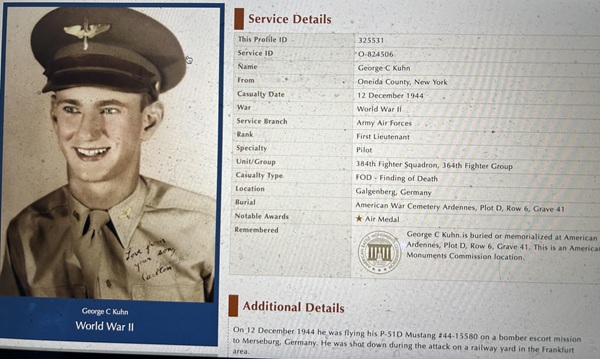 Lt. George C. “Carlton” Kuhn. |
|
On December 12, 1944, a P-51 Mustang crashed near Ziegenhain, Germany, killing its 23-year-old pilot, Lt. George C. “Carlton” Kuhn. I know of him only because of an arbitrary connection between the pilot and my mother at what was the height of so much death in a brutal war. Until now, the circumstances of the crash had been lost to history. Finally, there are answers for five American sisters who knew of their uncle but never had a chance to know him. As was customary at a crash site, the local German doctor was assigned to retrieve the dog tags and report the death to the Red Cross, along with a “finding of death.” That doctor was my grandfather, Dr. Karl Merkel. His driver was my mother, then 14-year-old Gisela. Now, thanks to a bit of research and the Internet, she is able, at nearly 96 years of age, to see for the first time a photograph of the young pilot. My family had heard the incomplete story many times, along with her many other war stories of a time before she met and married my U.S. military father: She told us of ditching a coveted bicycle on the way to school to avoid fighter planes that “shot at everything that moved.” Of hearing Hitler’s rants on the radio. Of the death of a teacher as bullets rained from airplanes above a train platform. Of American soldiers on the front line tossing oranges. And of a brainwashed generation of Hitler Youth being handed Panzerfausts near the end of the war with an assignment to destroy American tanks. (Instead, a beaten population wanting no more of war threw them in the moat.)
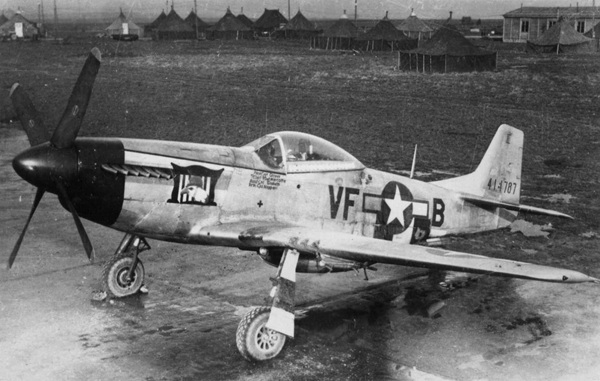 A North American P-51D Mustang. The plane crash happened in a potato field just outside the village in a place known as a medieval court and gallows, Galgenberg. A truck, one of very few vehicles allowed petrol to travel and likely involved in the transportation of farm products, must have caught Lt. Kuhn’s attention as he was heading back to England with his wingman, Lt. Jack V. Johnson, whose plane had been damaged by FLAK while the pair escorted bombers to a Frankfurt rail yard. Lt. Kuhn may have believed it to be a military truck, or it may have simply “caught his eye.” After shooting at the truck, Kuhn didn’t pull the plane up fast enough and it struck treetops and overhead electrical wires before crashing. Arriving at the scene of the crash, my grandfather realized this was not a place for his daughter and sent her to walk the short distance home, but not before she had witnessed yet another casualty of war in the mingling of body and plane parts. The surname Kuhn she remembered, but only because it confused her. It was not an enemy name, but German – the same as a family living in the village. Neither Kuhn nor Johnson were ever heard from again. No details of any crash were recorded in military records at a time when information gathering was difficult. Both deaths were eventually attributed to “combat” in letters to Kuhn's mother from the War Department which initially listed him as missing in action. A search of military records today reveals that Lt. Kuhn was a decorated pilot born and raised in Chadwicks, New York. A 1939 graduate of Chadwicks High School, he joined the Air Corps in Albany in November of 1942 when he turned 21. He was a boy with big ears, second from left in the top row of neatly attired 8th graders. He had a sister Marie and a brother James, who became a veterinarian. Assigned to the 364th Fighter Group, Lt. Kuhn is buried beneath a white cross at the American Military Cemetery in the Ardennes, Belgium. Finding his records, I was able to find his surviving five nieces and put them in touch with my mother. They are eager to meet the only connection they have to the crash site, my mother Gisela who will turn 96 in a few weeks. No winners or losers in war, but the lingering loss of a bright-eyed smiling young man who loved to fly. Together soon, the nieces and my mother will mourn the young man 82 years after his untimely death. Remembering 1944 Editors Note: This report flies in the face of our cardinal rule that everything in The Sandisfield Times has to have a Sandisfield connection. There is a connection, but it’s as tenuous as it gets. The author is a Sandisfield resident and a terrific reporter who has written for newspapers in Connecticut and Massachusetts, including The Times. That’s some help, but not enough. The story is about her mother. Still not enough. The real reason this report is published here in our July issue is that it reminds us of Memorial Day, just past, and now the 4th of July. It reminds us of the 250th anniversary of the Republic, patriotism, and sacrifice. It is a story of World War II, a pilot who never came home, and a woman who has kept a clear memory for 82 years. The story touches all of us. |

|
©The Sandisfield Times. All rights reserved.
Published July 1, 2026